Gain/Loss Asymmetry
Description
The gain/loss asymmetry refers to the observation that the speed of price fall is faster than that of the price rise. [Jensen_2006]
\begin{equation}
T^{t}(\theta) = \left\{ \begin{array}{ll}
\inf{\{ t'| \log{p_{t+t'}}-\log{p_{t}} >=\theta,t'>0 \}} & (\theta>0) \\
\inf{\{ t'| \log{p_{t+t'}}-\log{p_{t}} <=\theta,t'>0 \}} & (\theta<0).
\end{array} \right.
\end{equation}
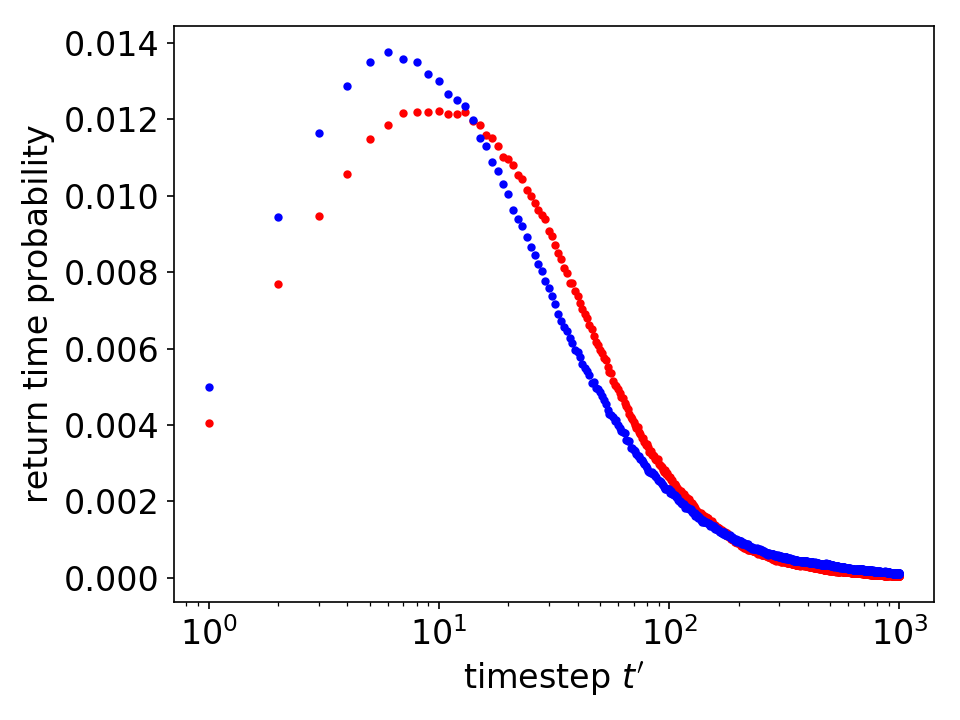
Fig. Averaged result for S&P500 firms daily price return
Code Example
import datetime as dt
import pandas_datareader.data as web
import numpy as np
import stylefact.finance as sff
import stylefact.visualize as sfv
st = dt.datetime(1990,1,1)
en = dt.datetime(2020,1,1)
data = web.get_data_yahoo('GM', start=st, end=en)
prices = data['Adj Close'].to_numpy()
log_prices = np.log(prices)
returns = np.diff(log_prices)
positive_dist,negative_dist = sff.gainloss_asymmetry(returns)
sfv.gainloss_asymmetry(positive_dist,negative_dist,'gainloss_asymmetry')
References
| [Bac00] | Louis Bachelier. Théorie de la spéculation. Annales Scientifiques de l’École Normale Supérieure, 3:21–86, 1900. |
| [CTPA11] | Anirban Chakraborti, Ioane Toke, Marco Patriarca, and Frédéric Abergel. Econophysics review: i. empirical facts. Quantitative Finance, 11(7):991–1012, 2011. |
| [Con01] | Rama Cont. Empirical properties of asset returns: stylized facts and statistical issues. Quantitative Finance, 1(2):223–236, 2001. |
| [GG03] | V. V. Gavrishchaka and S. B. Ganguli. Volatility forecasting from multiscale and high-dimensional market data. Neurocomputing, 55(1):285–305, 2003. |
| [JJS06] | Mogens H. Jensen, Anders Johansen, and Ingve Simonsen. Inverse statistics in economics: the gain-loss asymmetry. Physica A, 324(1-2):338–343, 2006. |
| [MDD+97] | Ulrich A. Müller, Michel M. Dacorogna, Rakhal D. Davé, Richard B. Olsen, Olivier V. Pictet, and Jacob E. von Weizsäcker. Volatilities of different time resolutions - analyzing the dynamics of market components. Journal of Empirical Finance, 4(2):213–239, 1997. |